
Planning a Complete Remote Workforce Housing Package
share this Post
Planning remote workforce housing involves more than selecting modular buildings. Your crew also needs reliable power, potable water, wastewater service, HVAC, furnishings, and ongoing support.
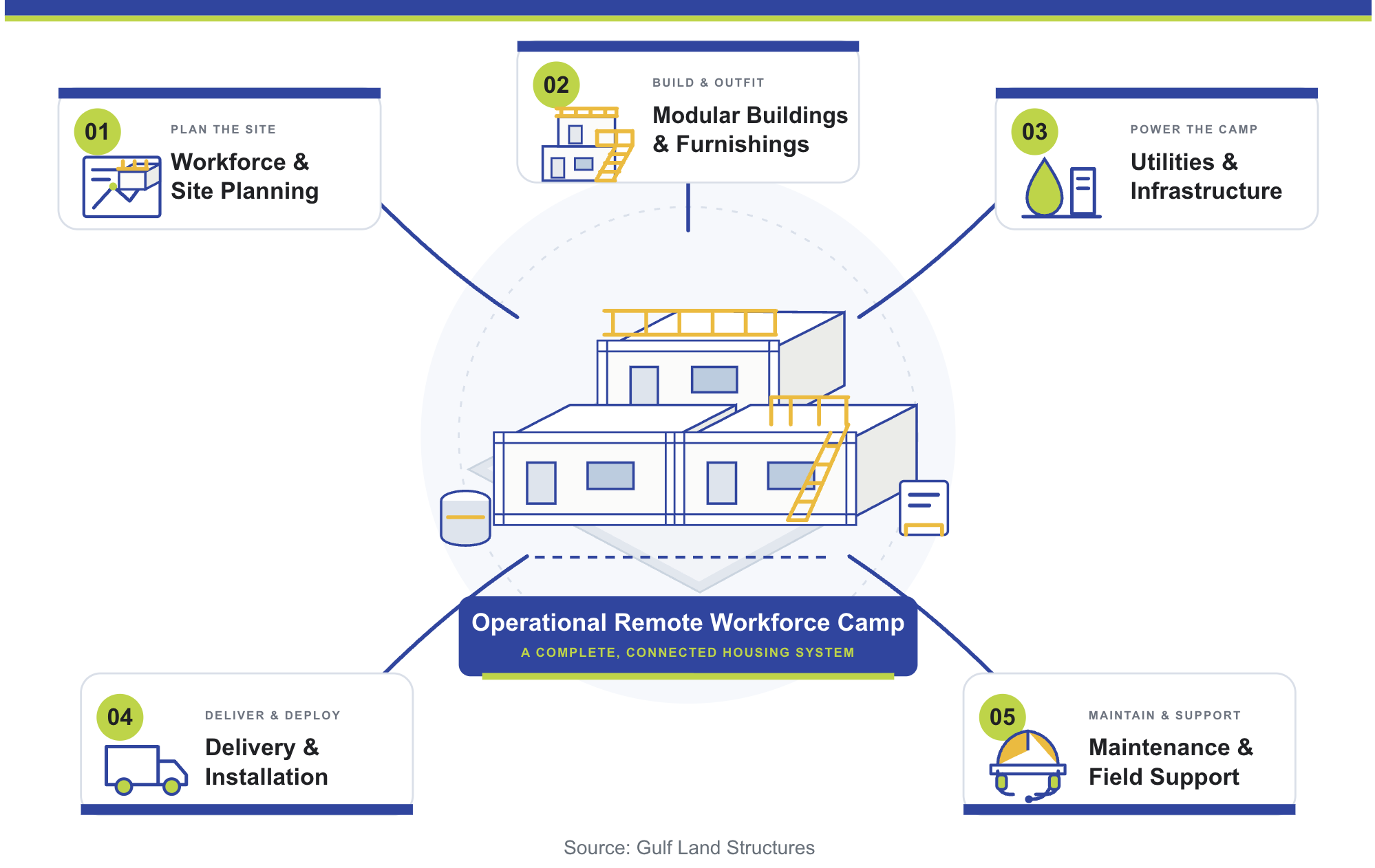
That is why a complete remote workforce housing package should be planned as one connected system. Your workforce determines the modular buildings you need. Those buildings determine utility demand. Your site and schedule shape how the camp will be delivered, installed, and supported.
When these pieces are coordinated from the start, your team gets an operational work camp with clear responsibilities and fewer unresolved needs after mobilization. Use this article as a checklist for planning or comparing a complete remote workforce housing package.
In this article, we’ll cover:
- How workforce and site needs shape a remote workforce camp plan.
- Which modular buildings, furnishings, and utilities a complete package should include.
- How to compare companies offering complete remote workforce housing solutions.
- How Gulf Land applies more than 130 years of combined living quarters experience to remote workforce housing.
Plan Remote Workforce Housing Around Your Crew and Site
Every complete remote workforce housing package starts with the people who will use it. Headcount matters, but it is only one part of the plan.
Project teams should also consider work schedules, room occupancy, length of stay, climate, location, existing infrastructure, and potential changes in workforce size. Shift changes can also affect kitchen, dining, shower, and laundry capacity, even when the number of beds stays the same.
Defining these operating needs creates the foundation for the rest of the package. Once they are clear, your team can select the right modular camp buildings and calculate the infrastructure needed to support them.
Select and Equip Modular Buildings for Remote Workforce Housing
Once you understand how the camp will operate, you can translate those needs into a modular building plan. Remote workforce housing usually requires more than sleeping quarters. Crews also need places to eat, shower, do laundry, receive first aid, meet, store equipment, and rest between shifts.
What Modular Buildings Should a Remote Workforce Camp Include?
The exact mix will depend on the project, but a complete remote workforce housing package may include the following modular buildings:
- Sleeping Quarters
- Restrooms and Shower Facilities
- Laundry Buildings
- Commercial Kitchens or Galleys
- Dining Halls and Break Areas
- Recreation Buildings
- Offices and Meeting Rooms
- First-aid and Security Buildings
- Storage Buildings and Maintenance Shops
Selecting the buildings is only part of the scope. Each modular building must also contain the furniture, appliances, fixtures, and equipment required for its intended use.
“Fully furnished” can mean different things from one remote housing proposal to another. Ask for an itemized schedule covering beds, lockers, office furniture, commercial kitchen equipment, refrigeration, laundry equipment, lighting, plumbing fixtures, and life-safety equipment.
The proposal should state who supplies, installs, tests, maintains, and replaces each item. This prevents “available” from being mistaken for “included and ready to use.”
Size Remote Camp Utilities and Infrastructure for Total Demand
Once the modular building mix is set, the project team can calculate the demand those buildings will place on camp infrastructure. Power, potable water, wastewater, HVAC, and refrigeration should be planned for the complete occupied camp. Sizing these systems one building at a time can leave the finished site without enough capacity.
What Utility Systems Should a Complete Remote Workforce Housing Package Include?
A complete remote camp infrastructure package may include:
- Primary and Backup Power Generation
- Fuel Storage and Electrical Distribution
- Potable Water Treatment and Storage
- Reverse-osmosis Water Makers, Pumps, and Pressure Sets
- Hot Water Systems
- Wastewater Collection and Treatment
- HVAC and Refrigeration Equipment
- Controls, Replacement Parts, and Maintenance Support
Before approving the package, confirm system capacity, backup requirements, operating responsibility, maintenance responsibility, and plans for camp expansion. Qualified professionals should also confirm the final design against requirements that apply to the project and location.
OSHA’s temporary labor camp standard addresses water supply, bathing, laundry, sanitation, and other camp conditions. Its construction sanitation standard also covers potable water, toilets, washing facilities, and food service. The U.S. Environmental Protection Agency provides additional guidance on how septic systems work and different types of septic systems.
With the buildings and utilities defined, the focus shifts to getting the complete camp to the site and ready for occupancy.
Coordinate Modular Building Delivery, Installation, and Field Support
A complete remote workforce housing package should explain how the modular buildings and equipment will move from fabrication to operation.
The Modular Building Institute explains that modular construction involves coordinated design, fabrication, transportation, assembly, and installation. Fabricating modular buildings off-site can simplify work at the final location, but it does not eliminate site planning.
Before mobilization, assign responsibility for:
- Site Preparation and Foundations
- Transportation, Staging, and Lifting
- Setting and Securing the Modular Buildings
- Utility Connections
- Inspections and Approvals
- Testing and Commissioning
- Final Preparation for Occupancy
Support should continue after the remote workforce camp opens. The proposal should identify who will maintain the buildings, utilities, HVAC, refrigeration, plumbing, and electrical systems. Remote sites can be difficult to reach, so unclear service responsibilities can lead to longer periods of downtime.
Compare Complete Remote Workforce Housing Providers
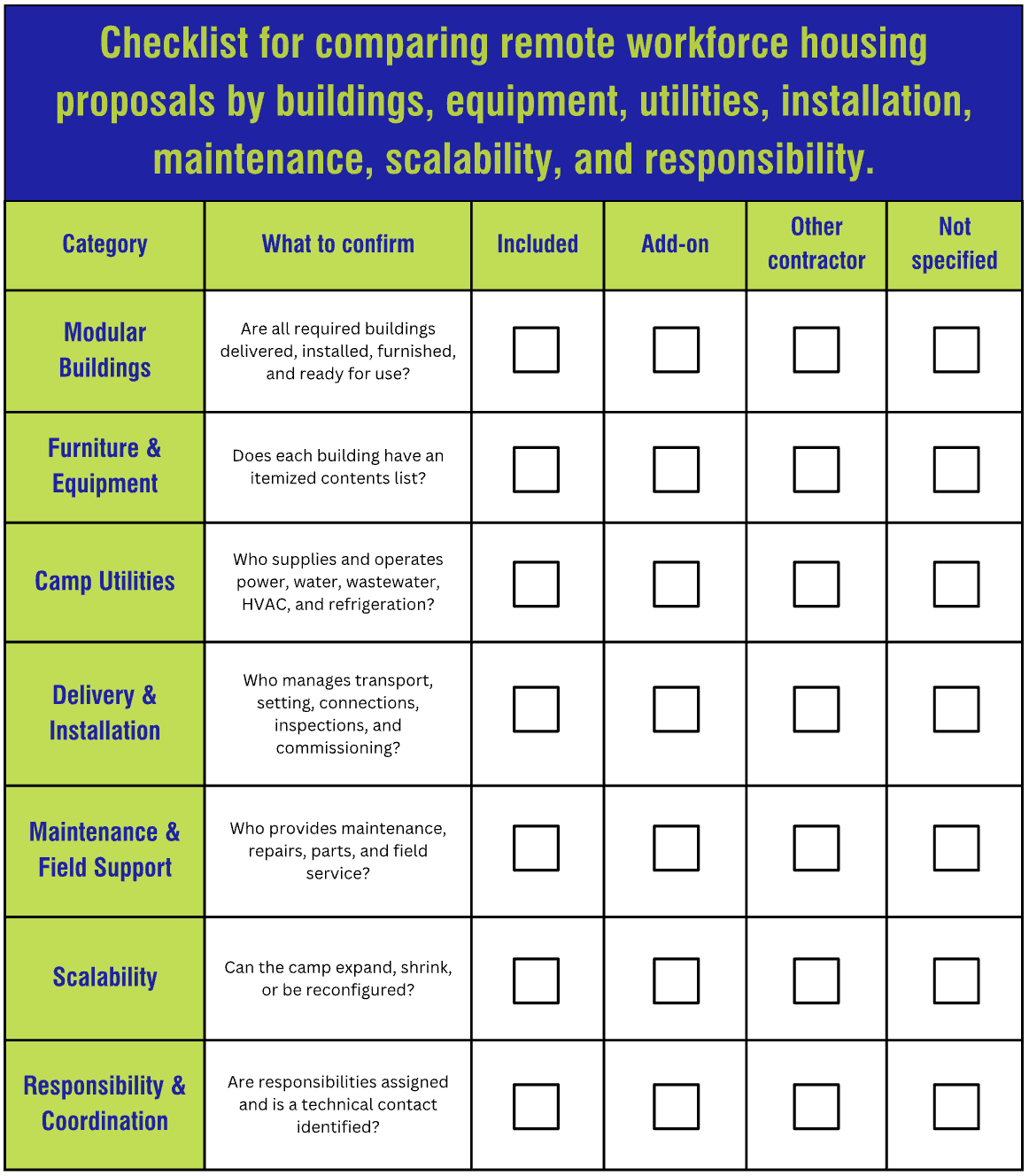
The final step is comparing the complete operating scope, not just the modular building catalog or quoted bed count. A lower building price may not represent a lower total project cost if furnishings, utility equipment, installation, or field support are excluded.
What Should You Confirm in a Remote Workforce Housing Proposal?
For each package component, determine whether it is included, available as an add-on, supplied by another contractor, or not specified.
The Key Takeaway: Plan the Remote Workforce Camp as One System
A complete remote workforce housing package should be planned around one outcome: a camp that is equipped, connected, commissioned, and ready to support daily operations. This means confirming whether the provider can coordinate the modular buildings, furnishings, utilities, installation, and field support needed to move the camp from delivery to operation.
Explore Gulf Land’s Complete Remote Workforce Housing Solutions
Gulf Land Structures can provide a coordinated remote workforce housing package that combines modular accommodations, furnishings, support buildings, utilities, jobsite equipment, and technical services.
Our services include the design, construction, rental, and servicing of modular buildings and living quarters for onshore, offshore, and remote projects. Gulf Land also offers more than 200 rental buildings and jobsite equipment, including generators, reverse-osmosis water makers, potable-water tanks, pressure sets, sewage-treatment equipment, portable lighting, and HVAC units.
This work is backed by more than 130 years of combined living quarters experience across our management team and technical staff. Our experienced engineering and design teams bring a flexible, practical approach to solutions developed around each project’s site conditions, workforce needs, and operating requirements.
Explore our workforce housing rental solutions for inland, offshore, island, and other infrastructure-limited locations.