
From Temporary Housing to Long-term Operations: What to Plan
share this Post
A permanent work camp may take time to complete, but the project cannot always wait. Crews still need housing, supervisors still need field office space, and the site still needs utilities, sanitation, access, and daily support.
Planning those temporary facilities early can help project teams avoid delays and keep the job moving from day one. Here is what to consider when bridging the gap between early construction and long-term operations.
In this article, we’ll cover:
- How to plan temporary facilities as the project’s first base of operations.
- What crews need beyond sleeping space, including utilities, sanitation, access, and daily support.
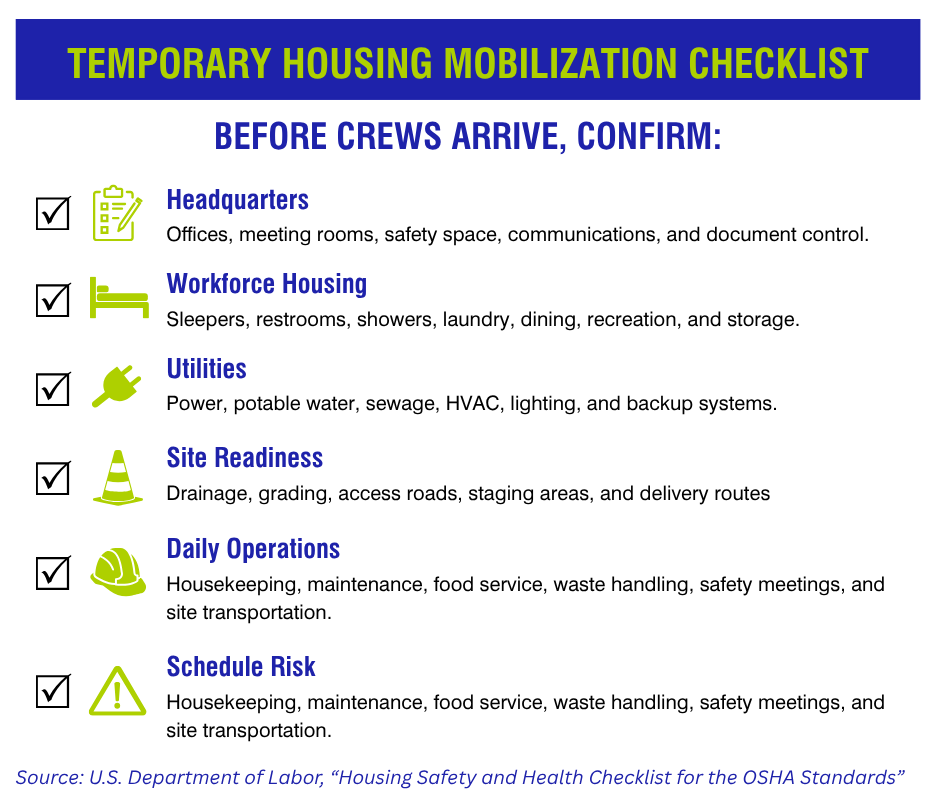
- What project teams should confirm before mobilization to avoid delays before the permanent work camp is ready.
Start With the Temporary Base of Operations
Before the permanent camp is complete, the project still needs a place to operate. Decisions still have to be made, crews still have to be coordinated, and safety, scheduling, documentation, and communication still have to happen every day.
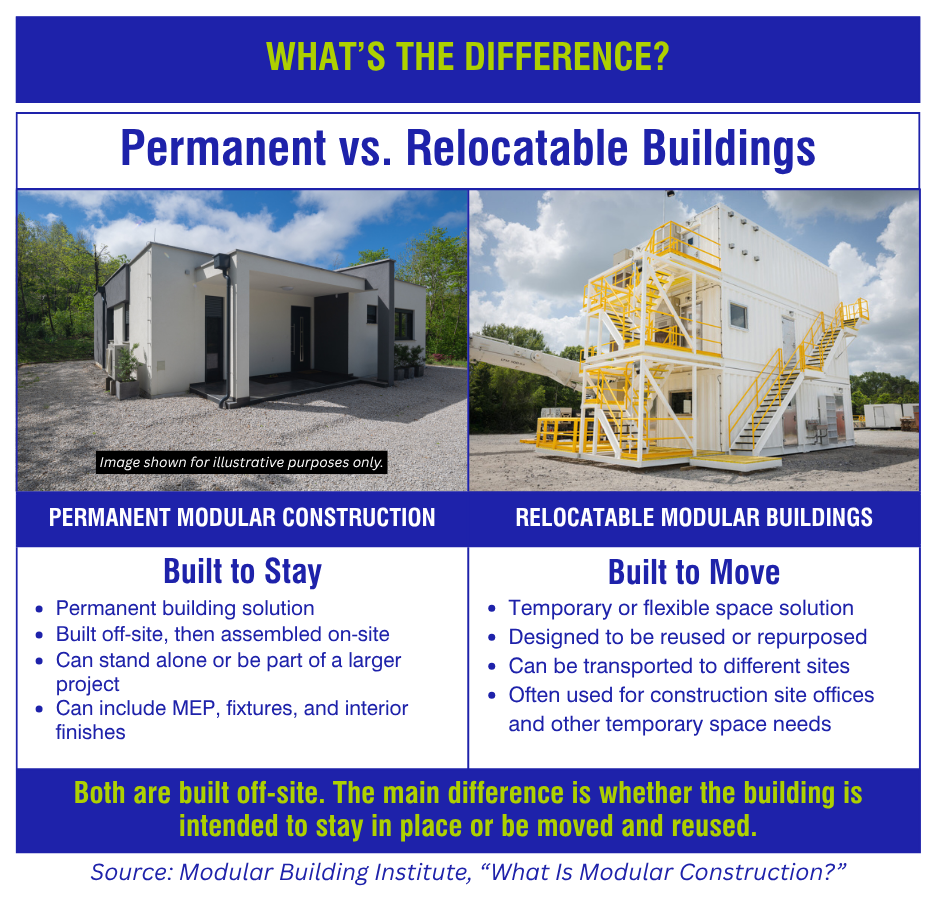
That is why temporary facilities should be planned as the project’s first base of operations, not just a collection of buildings. Depending on the project, that base may need to include offices, meeting rooms, or more.
Relocatable modular buildings can be especially useful in this early phase, according to the Modular Building Institute (MBI). The MBI notes that relocatable buildings are often used for construction site offices and temporary space needs where speed, flexibility, and the ability to move or reconfigure space are important.
The goal is to give the project team a functional headquarters before the permanent camp is ready. If that space is too small, poorly located, or disconnected from utilities and support services, the temporary setup can create friction at the exact point when the project needs momentum.
Plan Housing Around Real Occupancy and Daily Use
Once the project has a temporary base of operations, the next question is whether the site can support the people living and working there.
The Occupational Safety and Health Administration’s (OSHA) temporary labor camp and construction sanitation standards point to several planning factors, including sleeping space, potable water, toilets, showers, laundry, lighting, refuse disposal, sewage disposal, and sanitary food service. In other words, temporary housing has to support daily life, not just overnight rest.
When these needs are planned early, the camp is more likely to function smoothly from the start. When they are missed, the project can face avoidable issues with comfort, cleanliness, logistics, and crew productivity.
Build Temporary Facilities Into the Schedule Early
Temporary does not mean simple or last-minute. If the buildings, utilities, site access, transportation, installation, and inspections are not planned early, the temporary setup can become one of the first schedule risks on the project.
Off-site construction standards from the International Code Council and Modular Building Institute address planning, design, fabrication, assembly, inspection, and regulatory compliance. For project teams, that means temporary facilities should be coordinated alongside design and layout, fabrication timing, site preparation, transportation, utility tie-ins, local code requirements, and approvals.
Consider How Housing Affects Safety, Travel, and Productivity
Once the temporary facilities are planned into the schedule, project teams also need to consider how the housing plan affects the workforce itself. Location, layout, and access to daily support services can influence travel time, fatigue, shift changes, safety, productivity, and retention. This is especially important on remote projects.
On remote pipeline projects in the U.S., for example, crews may need to move between lodging sites, equipment yards, and the worksite. The National Institute for Occupational Safety and Health (NIOSH) notes that oil and gas workers often drive long distances to remote worksites, and that long trips combined with long shifts can lead to fatigue. NIOSH also identifies fatigued driving as a major cause of crashes in the oil and gas industry.
A temporary camp that is too far from the work, difficult to access, or missing basic daily support can add strain to an already demanding job. That matters in a labor market where construction crews are already hard to find and keep.
A recent survey from Associated General Contractors of America and NCCER found that workforce shortages continue to affect construction firms and contribute to project delays. Stronger housing logistics cannot solve every workforce challenge, but they can remove one avoidable obstacle to keeping the project staffed and moving.
What Project Teams Should Plan Before Mobilization
Temporary housing works best when it is planned as a complete operating environment, not a set of separate buildings. Headquarters, workforce housing, utilities, site access, and daily camp operations all depend on one another.
If one piece is missing, the entire setup can create friction. That is why project teams should confirm the basics before mobilization, especially when the permanent camp is not yet ready.
Gulf Land Structures: Turnkey Modular Support for Remote Project Success
That is where Gulf Land Structures can help. With more than 130 years of combined living quarters experience across our management team and technical staff, Gulf Land supports project teams with temporary modular housing, headquarters buildings, utilities, jobsite equipment, and field-ready accommodations before the permanent camp is complete.
Our fleet of more than 200 rental buildings and jobsite equipment helps teams mobilize faster while permanent modular solutions are being planned, fabricated, and installed. From temporary accommodations to supporting infrastructure, Gulf Land gives project teams a more seamless path from early mobilization to long-term operational support.
Download our Temporary Housing Comparison Guide to compare common workforce housing options and start planning the right solution for your project.