
Top Workforce Housing Mistakes That Delay Remote Projects
share this Post
Remote projects are often delayed by workforce housing decisions made too late or planned too narrowly. When modular housing is part of the plan, those early decisions can have a direct impact on schedule.
In fact, modular delivery can cut project timelines by nearly half when planned correctly, according to the non-profit trade association, the Modular Building Institute (MBI). The key is knowing where planning for workforce accommodations most often goes wrong and how to stay ahead of those issues.
In this article, we’ll cover:
- Why infrastructure gaps can delay workforce housing before the man camp is even in place.
- How treating housing like a late-stage purchase can create avoidable schedule setbacks.
- What transport, route, and installation constraints can slow modular housing delivery.
- Why space planning needs to account for support services, not just bed count.
- How day-to-day camp operations can affect efficiency, safety, and project momentum.
- What a better planning approach looks like and why experienced housing partners matter.
Mistake #1: Assuming the Site Can Support Housing Without a Full Infrastructure Check
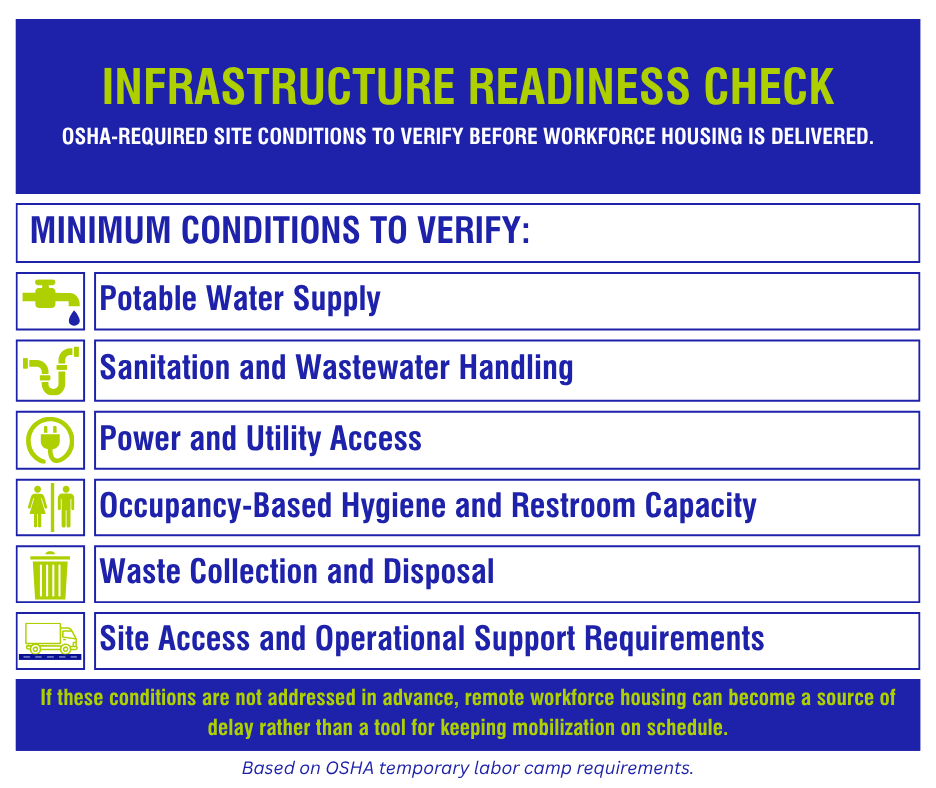
One of the fastest ways to delay a remote construction project is to assume the site can handle housing before the basics are verified. The Occupational Safety and Health Administration (OSHA) makes clear that workforce accommodations need adequate water, sanitation, and support systems in place, not just sleeping space. That includes enough water for drinking, cooking, bathing, and laundry, with minimum capacity tied to occupancy.
Guidance from the International Finance Corporation and the European Bank for Reconstruction and Development makes a similar point: housing plans should account for local infrastructure, wastewater, utilities, and community impacts early, before buildings are delivered. If the site is not ready to support the man camp, the camp can delay the project.
Mistake #2: Treating Workforce Housing Like a Late-Stage Procurement Item
Another common mistake is treating workforce housing like something that can be sourced late, after the core project plan is already in motion. The Whole Building Design Guide, a program of the National Institute of Building Sciences, frames off-site construction as a full process that includes planning, design, fabrication, transport, and assembly, not just delivery.
The MBI reinforces the same idea. When housing is planned early, site preparation and fabrication can move in parallel, helping compress schedules. When it is pushed too late, teams are more likely to run into permit issues, coordination gaps, and avoidable setup delays.
Mistake #3: Underestimating Transport, Route, and Installation Constraints
Even when the housing itself is ready, the project can still slow down if teams underestimate what it takes to get it on the construction site and set it in place. NAIOP, a commercial real estate development association, notes that modular components face transportation-related size and design constraints, and that delivery routes, oversized-load permits, overhead wires, and on-site storage all have to be considered before installation begins.
The MBI makes a similar point, calling transportation the “missing link” because poor planning can lead to rerouting, delays, and budget overruns. The International Code Council also notes that local approvals and inspections can create added challenges, especially when off-site components are coming from outside the jurisdiction.
Mistake #4: Miscalculating How Much Space and Support the Workforce Actually Needs
One of the easiest planning mistakes is to count beds without fully accounting for how people will live and work once they arrive. OSHA sets minimum expectations not just for sleeping space, but also for showers, toilets, handwashing, laundry, and water supply based on occupancy.
International worker-accommodation guidance also makes the same point from a broader planning perspective. Space needs should reflect the actual workforce, length of stay, and day-to-day camp operations, not a rough headcount. When housing is undersized or support facilities fall short, congestion, inefficiency, and avoidable project disruptions tend to follow.
Mistake #5: Planning the Structures, But Not the Day-to-Day Camp Operation
Getting the buildings in place is only part of the job. Remote projects also need a workable plan for how the camp will function day-to-day, including sanitation, food service, housekeeping, maintenance, safety, and worker well-being. International worker-accommodation guidance makes clear that housing should be managed as an ongoing operation, not just a one-time installation.
OSHA reinforces that idea through requirements tied to sanitation, hygiene, ventilation, and other living conditions. If those operational details are overlooked, even a well-planned housing setup can become a source of inefficiency, dissatisfaction, and project delays.
How to Avoid These Delays: A Better Way to Plan Remote Workforce Housing
Avoiding delays starts with treating workforce accommodations as part of project execution, not a last-minute support item. A more disciplined approach includes a few fundamentals:
- Assess site readiness early.
Confirm water, wastewater, power, sanitation, and other support requirements before finalizing the housing plan.
- Plan housing in step with mobilization.
Align accommodation decisions with permitting, site preparation, logistics, and project schedules rather than sourcing units late.
- Account for transport and installation upfront.
Review delivery routes, permits, staging areas, and installation requirements well before units are dispatched.
- Size the camp for real occupancy.
Base the plan on actual workforce numbers, length of stay, and the support facilities needed to keep operations running smoothly.
- Plan for daily camp operations.
Maintenance, housekeeping, food service, and safety management should be considered from the beginning, not after the structures arrive.
When those pieces are addressed early and together, remote projects are far less likely to lose time to avoidable setbacks.
Why Experienced Housing Partners Make the Difference
Avoiding delays is not just about selecting the right building type. It is about working with a partner that understands how housing decisions affect logistics, setup, safety, maintenance, and day-to-day operations in the field. That is where experience matters.
Gulf Land Structures brings a turnkey approach to remote workforce housing, backed by more than 130 years of combined experience in the living quarters industry. Customers have come to trust the flexibility and innovative approach of our engineering and design teams, including proven experience in remote island locations as an early leader in the Bahamas market.
On remote projects, that kind of expertise can help keep mobilization on track and reduce the risk of preventable delays. For teams evaluating their options, our temporary housing comparison guide offers a practical way to compare trailers, flat packs, and modular buildings based on project needs.